
Trek:USS Scorpio
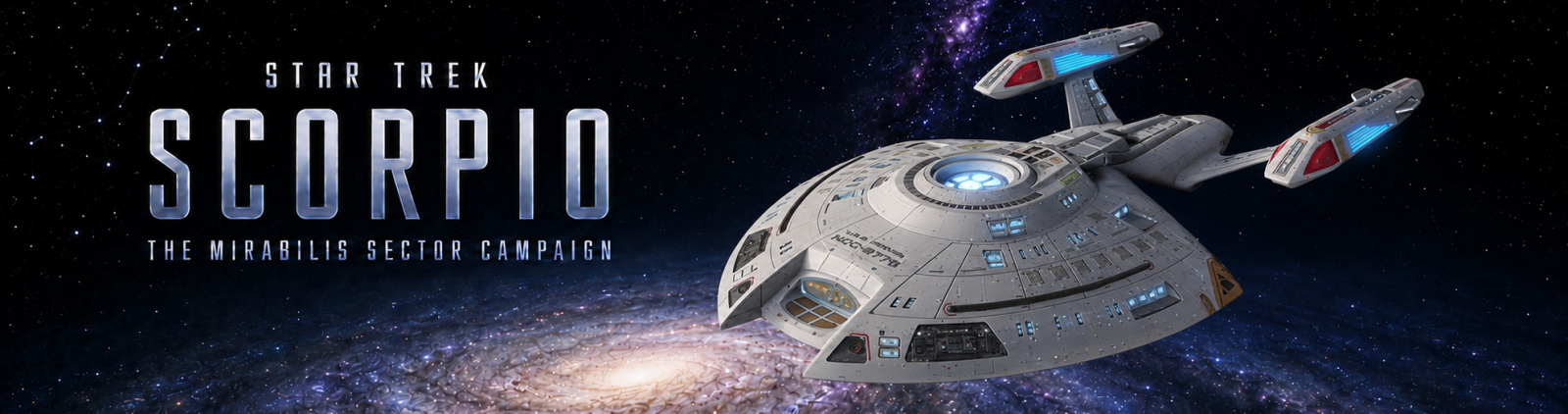
USS Scorpio
[edit]The USS Scorpio (NCC-754321) is a small Starfleet science vessel built for exploration after the Dominion War. She carries no families, no diplomatic entourage, and none of the spacious public life of a Galaxy-class starship. She is a working ship: compact, capable, and intimate enough that everyone aboard knows who keeps her flying.
The Scorpio belongs to the Zodiac group of Nova-class explorers. Like her sister ships, which include the USS Aries, USS Sagittarius, and USS Gemini, her advanced sensors and laboratories make her exceptionally well suited to survey work, stellar and subspace research, and the investigation of phenomena too distant or obscure to justify assigning a large cruiser. Her current assignment has taken her to the Mirabilis Sector, a remote region near the galactic north pole where Starfleet has little established presence and almost everything is being encountered for the first time.
Starfleet Vessel Record
| Field | Record |
|---|---|
| Name | USS Scorpio |
| Class | Nova class |
| Configuration | Postwar explorer conversion |
| Affiliation | United Federation of Planets, Starfleet |
| Commanding officer | Captain Maggie Riordan |
| Executive officer | Commander Q’arl, Klingon Defense Force exchange officer |
| Second officer | Lieutenant Commander Rigg Orosa |
| Assignment | Long-range exploration of the Mirabilis Sector |
| Primary role | Scientific survey, first contact, and investigation of unfamiliar phenomena |
A Small Ship for a Large Mission
[edit]The Nova class was never intended to be a mobile starbase. The Scorpio has the laboratories, sensors, flight facilities, medical support, and independent systems required for serious exploration, but little space that exists merely for prestige. Corridors are short. Senior officers live close to one another. The captain can reach the bridge, auxiliary control, the wardroom, or the computer core without crossing a small city to do it.
That scale gives the ship much of her character. A crisis is not something happening twenty decks away to people the command crew may never meet. When the flight crew loses a pilot, when Environmental Systems reports a containment problem, or when Engineering works through the night to keep the ship alive, the loss and labor are felt throughout the vessel.
The Scorpio is not a warship. Starfleet’s postwar reconstruction returned the Nova design to the work for which it was best suited: exploration. Wartime additions were removed, and the available volume and power were redirected toward sensors, laboratories, and the equipment needed to sustain a small crew far from established Federation support. She retains the defensive systems expected of a Starfleet vessel, but her first advantages are information, judgment, and the ability to recognize a danger before it becomes a battle.
The Scorpio is large enough to carry the crew into the unknown, but small enough that the players’ decisions affect the whole vessel. There is no anonymous lower-deck population waiting to solve the problem offscreen. The people making the difficult choices are also the people who will live with the consequences.
Explorer Conversion
[edit]The Scorpio was built as part of Starfleet’s return to exploration following the Dominion War. She incorporates the improvements developed for the postwar Nova program without becoming a larger or more luxurious vessel.
Her most important asset is an advanced sensor suite. The ship can conduct broad astronomical surveys, examine subspace phenomena, support detailed planetary study, and coordinate several scientific departments without depending upon a larger vessel for analysis. Those sensors have already been used to study an antimatter nebula, trace the course of a star moving under artificial power, and investigate a subspace relay connected to the Mirror Universe.
Her computer and laboratory resources support that mission, but they do not make the ship omniscient. The Mirabilis Sector repeatedly presents phenomena outside Starfleet experience. The sensors provide evidence; the crew must still decide what the evidence means.
Command and Operations
[edit]The main bridge occupies Deck 1, together with the captain’s ready room, a six-place briefing room, bridge systems, and command access. Its principal stations support helm, operations, command, tactical, science, and engineering. The room is designed for a compact working watch rather than the broad ceremonial space found aboard a flagship.
Deck 2 contains the primary computer core and secure data archive, the captain’s and executive officer’s offices, the wardroom, auxiliary control, and the senior officers’ cabins. The close placement of these spaces reflects the way the ship operates: command, analysis, and emergency control are kept within a short distance of one another.
The senior staff combines Starfleet officers, experienced enlisted specialists, and Commander Q’arl’s Klingon perspective. Captain Riordan is a scientist as well as a commanding officer, but the bridge is not governed by science alone. First contact, tactical danger, crew safety, engineering limits, and the captain’s responsibility to make a decision all meet there.
Science and Mission Systems
[edit]The Scorpio’s scientific role is broader than any single laboratory. Her mission systems support:
- astronomical, stellar, and subspace observation;
- planetary survey and environmental analysis;
- biological and medical investigation;
- first-contact research and cultural study;
- computer modeling and scientific simulation;
- analysis of unfamiliar technology and materials;
- deployment of away teams and auxiliary craft.
Industrial replicators allow the ship to fabricate specialized equipment and replacement components that ordinary personal replicators cannot provide. They extend her ability to work far from a starbase, although they cannot replace skilled engineering or manufacture a solution to every failure.
The Waverider
[edit]The Nova class carries a Waverider auxiliary craft fitted against the dorsal surface of the ship. The Scorpio’s Waverider is the Kumari, used for planetary operations, difficult atmospheric flights, and missions requiring more endurance or equipment than a shuttle can provide.
The Waverider’s return path includes quarantine isolation so that a vessel coming back from an unknown biosphere can be contained before its crew or cargo enters the inhabited sections of the ship. The arrangement is practical rather than dramatic: on an explorer, the most dangerous thing brought aboard may be invisible.
The Kumari was lost during the Kythera mission after the moving star’s subspace field overloaded her impulse systems and forced a crash landing. The accident killed Lieutenant Archambault and left the away team stranded with less than one hundred hours to prevent the destruction of Kythera and Zeuria.
Life Aboard
[edit]The Scorpio carries no civilian families or children. Everyone aboard is a working member of the complement, whether an officer, enlisted specialist, scientist, physician, or support crewman. The absence of families does not make the ship austere, but it does give her a different social character from the great exploratory cruisers of the previous generation.
Deck 3 is the center of ordinary crew life. Its crew accommodations surround a ring corridor, with the crew mess, galley, fitness center, lockers, Deck Services, two holodecks, and 3-Aft close at hand.
Crew Mess and Galley
[edit]The crew mess is the ship’s common dining room. Replicators provide most meals, but the adjoining galley gives the crew a place to prepare food rather than merely request it. On a small vessel, meals are one of the few occasions when people from different watches and departments reliably meet.
The Holodecks
[edit]The Scorpio has two holodecks with different ordinary uses. One is primarily recreational. The other supports engineering and scientific simulation, mission presentations, combat training, fitness testing, and other work intended to improve the ship’s readiness. Either can serve the other purpose when necessary, but their normal schedules reflect the distinction.
3-Aft
[edit]3-Aft is the ship’s small social lounge and bar. It offers synthohol rather than intoxicating alcohol and provides a place to sit off duty without pretending that a Nova-class explorer has room for a grand civilian nightclub. Its scale suits the ship: familiar faces, a view outside, and nowhere for senior officers to remain strangers to the rest of the crew.
Fitness and Deck Services
[edit]The fitness center and lockers support ordinary exercise, physical-readiness testing, and rehabilitation. Deck Services handles the practical needs that do not belong to a glamorous bridge department but determine whether a small vessel remains habitable over a long assignment.
Medical and Environmental Safety
[edit]Sickbay supports routine treatment, surgery, isolation, and the medical demands of away-team operations. The chief medical officer is Lieutenant Commander Sarnax, a Denobulan physician whose experience predates the current mission by decades.
Environmental Systems is important enough aboard the Scorpio to be represented among the senior specialists. Lieutenant Gallagher oversees the systems that keep the ship’s atmosphere, containment, and inhabited spaces safe. On a vessel that routinely studies unknown life and dangerous astronomical phenomena, environmental control is not housekeeping; it is part of the mission.
The ship also carries an Emergency Medical Hologram. Commander Q’arl dislikes relying upon it and has deactivated it when he judged its presence unnecessary.
Deck Guide
[edit]The current deck plans document the inhabited and command sections in detail.
| Deck | Principal spaces |
|---|---|
| Deck 1 — Command | Main bridge, ready room, briefing room, bridge systems, head and lockers, command access |
| Deck 2 — Command Support and Senior Accommodation | Primary computer core, secure data archive, captain’s office, XO office, wardroom, auxiliary control, senior officer quarters |
| Deck 3 — Crew Habitation and Recreation | Crew cabins, crew mess, galley, holodecks, fitness center and lockers, Deck Services, 3-Aft |
See USS Scorpio Deck Plans for the complete drawings and notes.
Mission Record
[edit]The Scorpio’s Mirabilis assignment has already tested nearly every part of her intended role.
- Kythera and Zeuria — The crew discovered a star moving under artificial power and corrected its course before it destroyed two inhabited worlds.
- The Ikaarians — The ship made contact with a humanoid civilization linked through a neural network of millions of minds.
- The Aurangzeb — Encounters with a territorial, egg-laying species revealed a conflict that cannot be solved simply by treating their biology as a disease.
- The Annutis Nebula — While mapping an antimatter nebula, the crew encountered incorporeal beings capable of producing deeply personal illusions.
- The Saurian colony — The Scorpio uncovered the use of rock-monster eggs in an attempted political overthrow.
The full account appears in the Mission Log.