
Peril:RPG/Characters
Make a Character
[edit]One index card. Five minutes. No angst.
A Peril Patrol character should fit on a 3×5 index card. If you need a Secret Origin, civilian identity, tragic childhood, tortured motivation, twelve Powers or forty minutes of arithmetic, you have brought the wrong character.
Find the joke. Make the character. Fight crime.
A complete character needs a Name, a one-line Concept, four Attributes, two Talents, one or two Powers, any important Signature Gear, a Running Gag, a Catchphrase!, Hit Points and Kabooms. That is the whole character.
Step One: Name
[edit]Give the character a superhero, supervillain, robut, monster or otherwise ridiculous name. Good names tell everyone immediately what sort of comic book they have wandered into: Mastermind, Chameleon, Tokyo Joe, Mister Chips, The Cavalier, Dr. Quake, Lobster Lord, Crime Mime or Paper Tiger all do the job.
Do not spend twenty minutes naming the character. You have four minutes left.
Step Two: Concept
[edit]Write one sentence describing the character. The Concept should tell everyone who this person is, what sort of role they fill, and preferably what kind of trouble they are likely to cause.
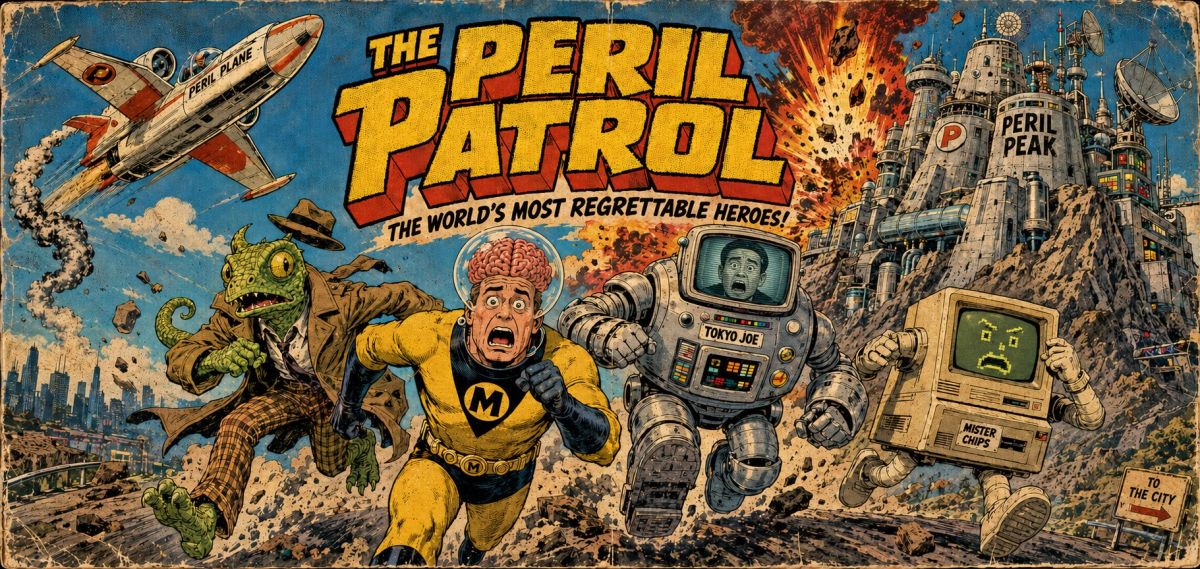
Mastermind — A pompous psychic superhero with an enormous exposed brain and unlimited confidence in his own genius.
Chameleon — A cowardly humanoid gecko shapeshifter who would rather not be here.
Tokyo Joe — A tiny, wildly enthusiastic pilot and mecha hero who considers caution an insult.
Mister Chips — An obsolete but highly competent robut who would very much like a transfer.
The Cavalier — An aging celebrity superhero in knightly armor whose glory days are behind him, though nobody has told him.
If the Concept requires a paragraph, shorten it.
Step Three: Attributes
[edit]Every character has four Attributes rated from 1 to 6. There is no point budget. Assign the numbers that fit the character, then let the Editor look them over and approve them. That is the balancing system.
Brawn
[edit]Brawn covers strength, toughness and physical force: punching, lifting, wrestling, breaking, throwing, shoving and holding up things that really ought to have their own structural supports.
Zip
[edit]Zip covers speed, reflexes and coordination: dodging, running, jumping, shooting, driving, piloting, balancing and catching something just before it hits the ground.
Brains
[edit]Brains covers intelligence, perception and technical ability: investigating, noticing, repairing, inventing, operating machinery, understanding science and analyzing clues.
Moxie
[edit]Moxie covers confidence, charm, bluffing, nerve and sheer brass: fast-talking, intimidating, impressing, grandstanding, issuing commands and acting like you obviously belong here even when you very clearly do not.
As a rough guide, 3 is ordinary competence, 4 is good, 5 is excellent, and 6 is ridiculous.
Step Four: Talents
[edit]Choose two Talents. A Talent is something the character is especially good at, such as Pilot, Martial Arts, Detective, Celebrity, Science!, Robotics, Computers, Guns, Shield Fighting, Explosives, Medicine, Sneaking, Criminal Underworld, Supervillains, Giant Robots, Alien Technology, Animals or Leadership.
There is no master list. If the Talent fits the character and seems likely to matter, it is probably fine.
A Talent is not a Power. Pilot means you are very good at flying aircraft; Flight means you do not need the aircraft.
Step Five: Powers
[edit]Choose one or two Powers. That is usually enough to give a character a strong superhero identity without turning the index card into a tax return.
Powers are broad abilities that let the character do things ordinary people cannot. Typical examples include Blast, Super-Strength, Flight, Speed, Armor, Force Field, Telekinesis, Mental Power, Transform, Invisibility, Teleport, Gadgetry, Resourceful, Super-Senses and Special Movement.
Powers do not have point costs or ratings, and they are not balanced against one another. If a character seems to have too much stuff, simplify the character rather than trying to price everything.
Special Effects
[edit]Define what the Power actually looks like in the fiction. Blast — Electricity, Blast — Ice, Blast — Psychic Force and Blast — Radioactive Syrup are all the same broad Power, but their Special Effects, or SFX, make them behave differently in the story.
The Power gives the broad ability. The SFX tells everyone what kind of ability it is. Full rules for flexible Power use and improvised Stunts are in Powers & Stunts!.
Step Six: Signature Gear
[edit]Write down any equipment that is central to the character. The Cavalier has his Shield, Gunbunny has her Guns, Tokyo Joe has his Giant Mecha, and Lobster Lord has his Lobster Battle Armor.
Signature Gear is assumed to be available unless the story specifically removes it, and Gear may also grant Powers. A jet pack might grant Flight, battle armor might grant Armor and Super-Strength, and a utility belt might grant Gadgetry.
See Gear, Vehicles & Robuts! for more.
Step Seven: Running Gag
[edit]Every character gets one Running Gag: a recurring behavior, weakness or situation that reliably gets them into trouble.
Mastermind never admits a mistake. Chameleon finds an excuse to leave whenever things become dangerous. Tokyo Joe commits enthusiastically before understanding the plan. Mister Chips requests transfer whenever the Peril Patrol behaves like the Peril Patrol. The Cavalier assumes strangers are fans.
When a Running Gag creates a genuine complication, it can earn a Kaboom. See Kabooms!.
Step Eight: Catchphrase!
[edit]Write one line the character is known for saying. It may be a battle cry, boast, threat, excuse, slogan or complaint.
Mastermind: “I meant to do that.”
Tokyo Joe: “SUPER YEAH! OK, CHIEF!”
The Cavalier: “People to see! Crime to fight!”
Lobster Lord: “We have much to learn from the lobster!”
Dr. Quake: “WHO CONTROLS THE EARTH CONTROLS THE WORLD!”
Catchphrases do not provide bonuses. A joke does not improve through compulsory repetition.
Step Nine: Hit Points
[edit]Roll 1d6 + 6. That is your Hit Point total.
Do not infer detailed body mass, bone density or armor thickness from this number. We are begging you.
Step Ten: Kabooms
[edit]Every character begins an issue with 2 Kabooms and can hold a maximum of 5. Write them on the card like this:
KABOOMS: ● ● ○ ○ ○
The full rules are in Kabooms!.
Your Index Card
[edit]A finished character might look like this:
Concept: Pompous psychic genius with an enormous exposed brain.
Brawn 2 • Zip 3 • Brains 6 • Moxie 5
Talents: Supervillains, Science!
Powers: Mental Power — Brainy-Blast; Telekinesis — Psychic Force
Signature Gear: Brain-protection helmet apparatus, when he remembers it
Running Gag: Never admits a mistake
Catchphrase!: “I meant to do that.”
HP: 8
Kabooms: ● ● ○ ○ ○
A complete character has a Name, Concept, four Attributes, two Talents, one or two Powers, Signature Gear if needed, a Running Gag, a Catchphrase!, Hit Points and Kabooms.
If it fits on the card and everybody understands the joke, you are finished.
Go fight something.
RPG Home • Characters! • Doing Stuff! • Fights! • Monologues! • Kabooms! • Powers & Stunts! • Gear! • The Editor! • Random Tables! • Issues & Series Play! • Pregens!