
Peril:RPG/Doing Stuff
Doing Stuff!
[edit]Say what you do. Roll only when it matters.
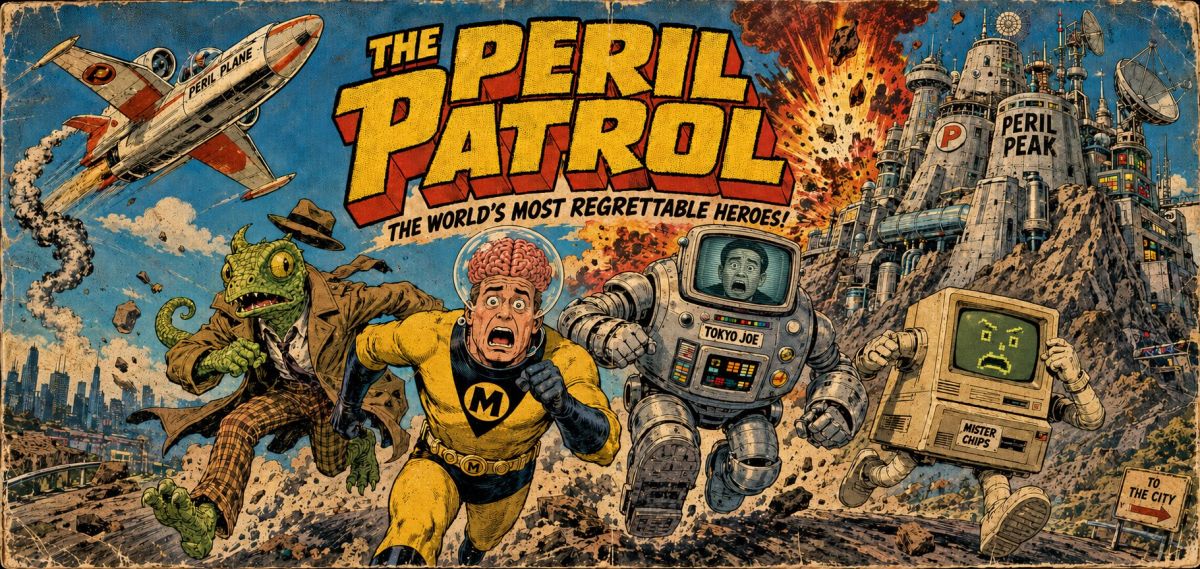
Most of the time, characters in Peril Patrol simply do things. If Tokyo Joe wants to fly the Peril Plane under ordinary conditions, he flies it. If Mister Chips wants to operate a computer, he operates it. If Gunbunny wants to reload, she reloads.
Roll only when failure matters, someone is actively opposing the character, the action is dangerous, the result is genuinely uncertain, or failure would make the issue more interesting.
Roll 2d6 + the appropriate Attribute.
If the total is 10 or more, you succeed.
A relevant Talent adds +2.
That is most of the game.
Pick an Attribute
[edit]Choose the Attribute that best matches what the character is actually doing.
Brawn handles strength, toughness and physical force.
Zip handles speed, reflexes, coordination, shooting, driving and piloting.
Brains handles intelligence, perception, investigation, science and technical work.
Moxie handles confidence, bluffing, intimidation, charm, nerve and sheer brass.
The same Talent may work with different Attributes depending on the situation. A character with Pilot might use Zip to fly through a collapsing tunnel, but Brains to identify an unfamiliar aircraft.
Talents
[edit]If one of the character's Talents clearly applies, add +2 to the roll.
Talents are intentionally broad. Do not waste time arguing over whether a Talent applies to one exact subcategory of an action. If the connection is reasonable and fits the character, use it.
For example, Detective might help Brains when examining a crime scene, while Celebrity might help Moxie when dealing with reporters or fans.
Difficulty
[edit]Most uncertain actions use a target number of 10.
Use 12 for a particularly difficult stunt and 14 for something genuinely ridiculous.
Routine Power use usually requires no roll. If an action is so easy that it would deserve a huge bonus, do not roll at all.
As a quick guide:
| Difficulty | Target | Example |
|---|---|---|
| Normal | 10 | Jump the gap, bluff the guard, hit the control panel |
| Big | 12 | Freeze the whole street, lift far above your usual scale, fly through collapsing debris |
| Ridiculous | 14 | Teleport the whole team, hold up a collapsing bridge, redirect an earthquake |
The Editor can also use small situational modifiers when that is easier than changing the target number. Keep them modest; +1 or –1 is usually enough.
Natural 12
[edit]A natural 12 on the dice is a spectacular success. The character does not merely succeed; something extra goes right.
A weapon might land neatly in the hero's hand after being shot away from a villain, the Peril Plane might clear the obstacle by inches, or a psychic probe might reveal exactly the clue everyone needed.
Do not stop to calculate an additional mechanical bonus. Improve the result and keep moving.
Natural 2
[edit]A natural 2 is a spectacular disaster. Something immediate and interesting goes wrong.
The wrong machine activates, the Blast hits an important piece of scenery, the disguise fools everyone except the one person who matters, or the vehicle begins moving before anyone has climbed aboard.
A natural 2 should change the scene. It should never mean only, “You fail.”
Opposed Actions
[edit]When two characters are directly working against one another, both roll:
2d6 + appropriate Attribute + any relevant Talent
The higher total wins.
This covers wrestling, chasing, sneaking past a guard, grabbing the same object, bluffing, intimidating and many forms of combat.
On a tie, neither side gets a clean victory. The punch is blocked, both characters grab the suitcase, the chase continues, or something else happens that keeps the conflict alive.
Helping
[edit]A character who can genuinely help another character gives +1 to the roll.
Only one helper normally provides this bonus. Three heroes shouting contradictory instructions do not provide +3. They provide a new problem.
The helper should describe what they are actually doing. If the help makes no sense in the fiction, there is no bonus.
Powers
[edit]Powers tell you what impossible things the character is allowed to attempt. They do not replace Attributes.
A character with Flight can fly, but Zip determines how well they handle a dangerous maneuver. A character with Telekinesis can move things at a distance, but Brains or Brawn may determine how well a particular stunt works. A character with Blast can make ranged attacks, but Zip usually determines whether the attack lands.
The Power provides permission. The Attribute provides the roll.
See Powers & Stunts! for the full Power rules.
Stunts!
[edit]A Stunt is an inventive use of an Attribute, Power, Special Effect, piece of Gear or the surrounding scenery.
Describe what you want to accomplish. The Editor decides whether it makes sense, chooses the Attribute and sets the difficulty. Then roll.
A Power entry gives the basic idea. It is not a list of permitted moves.
If the proposed Stunt makes sense for the Power's SFX, try it.
Superhero action should be inventive, excessive and slightly irresponsible.
A hero with Blast — Ice might attack a villain, freeze a roadway under a fleeing car, seal a doorway, create an ice ramp or freeze a weapon. A hero with Super-Strength might throw a car, hold up a collapsing roof, swing a lamppost through several Goons or lift something far beyond the character's normal scale.
Players are encouraged to invent new Stunts during play. If a particular Stunt becomes a favorite move, write it on the index card. It does not cost anything and does not become more powerful; it simply becomes part of the character.
Push It!
[edit]A character may attempt something clearly beyond the normal scale of a Power.
Examples include lifting a battleship, freezing an entire intersection, hitting several important villains at once, teleporting the whole team, holding up a collapsing bridge or throwing a tank across Skyscraper City.
A major stunt is usually target 12. A truly ridiculous stunt is usually target 14.
If the attempt is beyond even ordinary comic-book nonsense, the Editor may require the player to spend 1 Kaboom just for permission to try it.
Kabooms do not buy success. They buy the right to make an outrageous attempt.
Multiple Targets
[edit]Against ordinary Goons, one Stunt may affect as many nearby targets as the action reasonably covers. Roll once and resolve the group together.
Against important named characters, each extra target increases the difficulty by 1, to a maximum increase of +2.
So a normal attack against one named opponent is target 10, two named opponents are 11, and three or more are 12.
Do not count bullets, punches or individual attack rolls. Describe the action, roll once and keep the fight moving.
Failure Moves Forward
[edit]A failed roll should almost never stop the issue.
If the heroes fail to locate the villain's base, perhaps the villain finds them. If they fail to infiltrate a laboratory, the alarm goes off. If they fail a chase, the villain escapes somewhere interesting. If they fail to avoid capture, they may wake up inside the secret base they were trying to find in the first place.
The rule is simple:
Failure does not mean nothing happens.
Failure means something happens badly.
When inspiration fails, the Editor can simply ask the player, “What goes wrong?” Players are often very good at sabotaging themselves, and a genuinely in-character complication may even earn a Kaboom.
When Not to Roll
[edit]Do not call for a roll when the outcome is obvious, failure would add nothing, or the character is simply doing something they are clearly capable of doing.
The dice are there to create uncertainty and trouble. They are not there to make heroes roll for opening doors, walking across rooms or remembering how their own equipment works.
Save the dice for the moments that matter.
RPG Home • Characters! • Doing Stuff! • Fights! • Monologues! • Kabooms! • Powers & Stunts! • Gear! • The Editor! • Random Tables! • Issues & Series Play! • Pregens!