
Peril:RPG/Issues
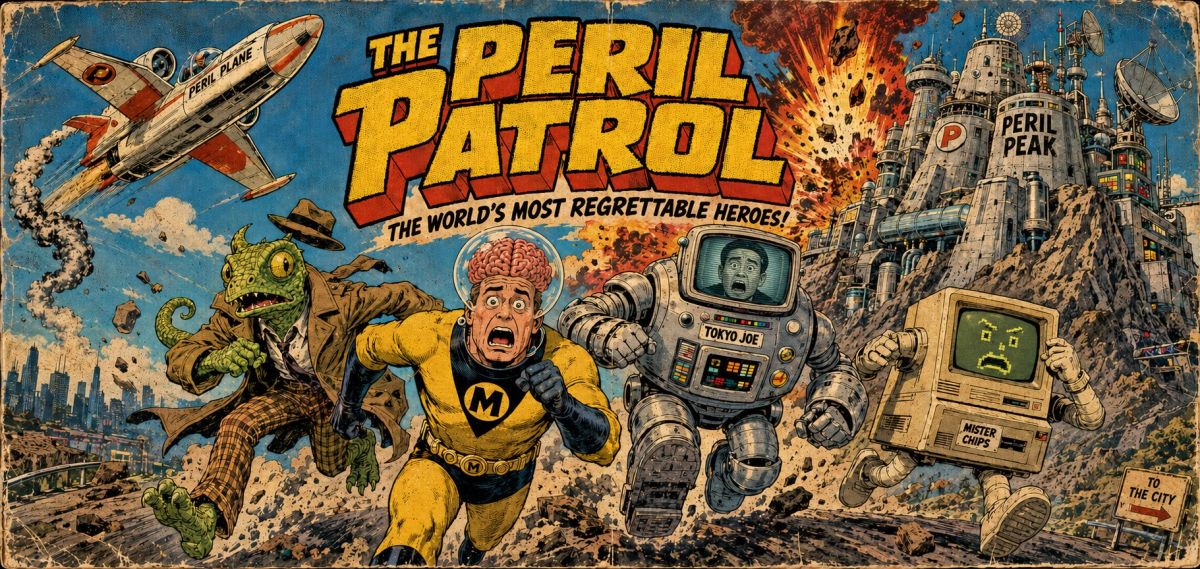
Issues, Series Play & Online Play
[edit]Make trouble. Escalate badly. End big. Come back next issue.
Peril Patrol works best as a series of short, energetic comic-book issues rather than carefully plotted epics. An issue should begin with trouble already happening, give the heroes something obvious to react to, let the situation become progressively more ridiculous, and end with one decisive Big Finish.
The same loose structure also makes the game well suited to recurring campaigns and online play. Continuity can matter without becoming a burden, and scenes can be short enough to handle through voice, text or a mixture of both.
Building an Issue
[edit]A complete issue can be prepared with five things:
- a Villain;
- a Scheme;
- a Place;
- a Complication;
- a Big Finish.
That is enough to begin.
For example:
Villain: Dr. Quake
Scheme: Shake Skyscraper City until everyone recognizes his genius.
Place: The underground Quake-O-Drome.
Complication: The Cavalier keeps calling him Kwak.
Big Finish: The earthquake machine reaches Maximum Quake.
You do not need to predict every scene. In fact, trying to do so is usually wasted effort. Players will ignore obvious entrances, befriend inappropriate Goons, destroy important machinery too early and invent solutions that make half your preparation irrelevant.
Good.
Prepare the problem, not the route through it.
The Five-Part Issue
[edit]A typical Peril Patrol issue has roughly five parts. These are not rigid acts; they are a useful rhythm.
1. Trouble!
[edit]Begin with something already happening.
A robot attacks. A bank disappears. A monster climbs a building. The Peril Phone rings. A villain hijacks the television signal. Something explodes for reasons that will become clear later.
Avoid opening with long meetings, shopping scenes or extended discussion of what everyone has been doing since last issue.
Start with the thing that demands action.
2. The Villain
[edit]The heroes discover who is responsible and what they want.
Often the fastest method is for the villain to tell them.
This is one reason Monologue! exists.
The reveal does not have to explain everything. It only has to give the heroes enough information to form a wrong idea about what to do next.
3. The Plan
[edit]The heroes devise a plan.
Allow this.
Encourage it.
Listen carefully.
Then remember that no plan survives contact with the Peril Patrol.
A good plan gives everyone direction and provides the Editor with several useful ways for things to go wrong.
4. Everything Goes Wrong
[edit]This is usually most of the issue.
The villain escalates. The machine activates early. The Goons misunderstand instructions. The heroes split up. Somebody pushes the wrong button. A Running Gag creates trouble. Kabooms begin to accumulate.
Failure should create new situations rather than dead ends.
If the heroes are captured, the issue continues inside the secret base. If the villain escapes, the chase continues somewhere worse. If the machine is destroyed too early, perhaps destroying it activates Phase Two.
The point is not to preserve the Editor's outline. The point is to keep producing playable trouble.
5. The Big Finish
[edit]Eventually the heroes attempt something decisive.
The Big Finish should feel larger, riskier or more ridiculous than the actions that came before it. This is where players spend Kabooms, Push Powers beyond ordinary scale, exploit Stupid Weaknesses and combine ideas that should not logically work together.
The villain is defeated, the city is saved, the machine explodes, the monster goes home or the entire problem is redirected somewhere technically less populated.
Finish with one last gag, then end the issue.
Do not linger through fifteen minutes of cleanup unless the cleanup itself is funny.
Start Late, End Early
[edit]Scenes should begin as close as possible to the interesting part and end once the important thing has happened.
Instead of playing every minute of travel to the museum, begin with:
- The Peril Plane lands badly outside the museum just as the roof explodes.
Instead of roleplaying the entire trip back to Peril Peak after the villain is defeated, cut to:
- Later, at Peril Peak...
This keeps the game moving and makes each scene feel like a comic-book panel rather than a surveillance recording.
Scene Cuts
[edit]The Editor should feel free to cut between characters, locations and simultaneous problems.
If Chameleon is hiding in the villain's laboratory while Tokyo Joe is chasing a giant robot through downtown, switch back and forth when one scene reaches a good moment of tension.
A scene cut is especially useful after:
- a failed roll;
- a dramatic reveal;
- someone becoming Out of the Panel;
- a villain escaping;
- a terrible decision;
- somebody saying, “Meanwhile...”
The Next Panel! Kaboom spend deliberately turns this principle into a player ability.
Cliffhangers
[edit]An issue can end on a cliffhanger if the group wants a two-part story.
Good cliffhangers leave the characters in a new, immediate problem:
- the villain activates the machine;
- the heroes discover the real mastermind;
- Peril Peak begins to collapse;
- something enormous rises from the harbor;
- everyone realizes the captured “villain” is a robot duplicate.
A cliffhanger should create anticipation, not simply stop the session because the clock ran out.
If possible, end with a line worthy of:
TO BE CONTINUED!
Series Play
[edit]A Peril Patrol campaign is a sequence of issues with recurring characters, places, jokes and villains.
It does not need a carefully mapped long-term plot.
The series grows naturally from what survives play.
The things most worth carrying forward are:
- recurring villains;
- allies and sidekicks;
- Running Gags;
- favorite Stunts;
- damaged reputations;
- ridiculous inventions;
- recurring locations;
- grudges;
- unresolved schemes;
- jokes everybody still enjoys.
Keep what generates play. Forget what does not.
Elastic Continuity
[edit]Continuity matters, but it should never become an administrative burden.
If Dr. Quake was sent to prison last issue, he can still appear again. Maybe he escaped. Maybe he was released. Maybe the prison had an earthquake problem. Maybe nobody explains it.
If the Peril Plane was destroyed, it can be rebuilt by next issue.
If a minor detail contradicts something from six sessions ago, decide whether anybody cares. If nobody does, keep moving.
Remember the things that make future issues better.
Everything else is negotiable.
Recurring Villains
[edit]Recurring villains are one of the best parts of series play.
Bring them back when:
- their Obsession suggests a new Scheme;
- the players still enjoy them;
- an old Stupid Weakness can be used differently;
- they can interfere with another villain;
- their return would make everyone at the table groan happily.
A returning villain does not need to become more powerful each time. They may simply arrive with a worse plan.
Villain alliances are also encouraged, particularly when the members are obviously incapable of working together.
Running Gags Over Time
[edit]Running Gags should evolve without becoming unrecognizable.
Chameleon may develop increasingly elaborate excuses for leaving. Mister Chips may begin drafting transfer requests before the emergency actually starts. The Cavalier may recognize recurring civilians as “old fans” whether they remember him or not.
If a Running Gag stops being funny, retire it or replace it with something that grew naturally from play.
The character is allowed to accumulate history.
They are not required to accumulate dignity.
Character Advancement
[edit]Peril Patrol does not need a conventional advancement system.
Characters are already superheroes, and the game is not about steadily increasing numerical power. Growth should usually happen through new favorite Stunts, recurring Gear, relationships, jokes and things established during play.
If a character genuinely changes enough to deserve a new Talent, Power or altered Attribute, the player and Editor can simply agree to change the card.
Do not count experience points.
Do not calculate improvement costs.
If the new version of the character is better for the series, use it.
Guest Stars
[edit]Guest heroes, villains and supporting characters are easy to add because character creation is so light.
A guest star only needs enough information to function in the issue. If they become important, fill in the rest later.
Guest appearances work especially well when the visitor:
- has history with a villain;
- clashes badly with one of the heroes;
- is much more competent than the Patrol;
- is much less competent than advertised;
- arrives expecting an entirely different kind of adventure.
Do not let guest characters take over the issue unless that is the joke.
Crossovers
[edit]A crossover is simply an excuse to make the cast problem larger.
When two teams meet, do not spend much time explaining why. Begin with the misunderstanding, shared emergency, villain alliance or transportation accident that brought them together.
Crossovers should create personality collisions as much as Power combinations.
The real question is not whether two heroes can combine their Blasts.
The real question is whether either of them can tolerate The Cavalier.
Public Service Announcement!
[edit]An issue may finish with the Public Service Announcement! rule.
The Editor assigns one player an absurdly harmless topic, and the player improvises a short in-character PSA. Completing it earns one bonus Kaboom for the next issue.
Suitable educational topics include donuts, cats, escalators, loose change, suspicious sandwiches and llamas, the well-known devil fish of the Atlantic.
This makes an excellent final beat after the main story has ended.
Online Play
[edit]Peril Patrol works well online because the rules require very little shared machinery. A character fits on an index card, combat does not depend on exact positioning, and most scenes can be resolved through description alone.
Voice chat works much like play at a physical table. Text chat needs a slightly different rhythm, but the underlying rules do not change.
Theater of the Mind
[edit]Peril Patrol assumes Theater of the Mind.
You do not need a grid, miniatures or exact distances. The Editor describes the important parts of the location and makes relative positions clear enough for everyone to act.
Useful descriptions sound like:
- The Masked Science Goons are clustered around the machine. Dr. Quake is on the upper catwalk. The main controls are beneath him, and the whole place is starting to shake.
That is enough.
Players can now make meaningful choices without knowing whether the catwalk is exactly thirty-five or forty feet away.
If exact positioning becomes important, clarify it in plain language.
Discord Voice Play
[edit]For voice play, use a normal voice channel and keep character sheets somewhere easy to reference. Dice can be rolled physically, with a dice bot or however the group prefers.
Because Monologues, Running Gags and Catchphrases rely on performance, voice play naturally supports much of the game's comedy.
The Editor should still keep scenes moving briskly. Online conversations can become slower than table conversations because people are trying not to talk over one another, so actively invite quieter players into scenes.
Discord Text Play
[edit]Peril Patrol can also be played entirely through text.
Text play should not attempt to imitate a spoken session line by line. Let each post accomplish something meaningful.
A useful player post usually contains:
- what the character does;
- any dialogue that matters;
- the intended result;
- the roll, if one is clearly required.
For example:
- Chameleon becomes a fire extinguisher and tries to blend in with the emergency equipment beside the door. “Nobody here but us extinguishers.” Transform Stunt, Moxie: 2d6+3.
The Editor can then resolve the action and advance the scene in one response.
This keeps text play from becoming a sequence of tiny posts where nothing happens.
Posting Order
[edit]Strict initiative is usually unnecessary in text play.
The Editor can ask everyone involved in a chaotic scene to post their intended actions, then resolve them in an order that makes dramatic sense.
If two actions directly conflict, use the normal opposed-roll rules.
If exact order matters, use Zip as the obvious guide rather than introducing a separate initiative system.
This asynchronous approach lets several players contribute without forcing everyone to wait for one person to finish a complete turn.
Keep Text Scenes Focused
[edit]Text play benefits from stronger scene framing.
The Editor should clearly establish:
- where everyone is;
- what the immediate problem is;
- which NPCs matter;
- what is changing right now.
Then ask for action.
Avoid enormous blocks of descriptive prose that leave players unsure what they are supposed to respond to.
A few vivid details are more useful than a complete architectural survey.
Quote Dialogue, Describe Action
[edit]In text play, readability improves when dialogue and action are easy to distinguish.
A simple style is enough:
- The Cavalier shoulders his way to the front and points dramatically at Dr. Quake.
- “Stand aside, citizens! Your hero has arrived!”
- He pauses and lowers his voice.
- “Mervin did tell them I was coming, didn't he?”
No special formatting system is required. Consistency matters more than ornament.
Reactions and Interruptions
[edit]Do not require a new full round every time somebody wants to react to a joke, Monologue or obvious danger.
Players can add short reactions freely when they do not change the mechanical situation.
If an interruption would materially change an action, the Editor decides whether it happens before, after or as an opposed action.
The goal is readable momentum, not procedural purity.
Dice in Text Play
[edit]When possible, include the roll in the same post as the attempted action. This saves an extra round of waiting.
If the Editor has not yet given a difficulty, the player can still roll the obvious Attribute and Talent. The Editor interprets the result once the post is read.
For unusually complicated Stunts, the player may ask first, but most actions should not require permission before anyone touches the dice.
The default remains:
Say what you are trying to do and roll when it obviously matters.
Monologues in Text Play
[edit]Text is particularly good for Monologues because players can actually write the ridiculous speech.
Do not require essays.
A few strong sentences are enough.
Players who enjoy producing a longer villain manifesto may do so, but the Editor should never make prose length determine the mechanical strength of the Monologue.
The roll still decides that.
Kabooms in Discord
[edit]Kabooms should remain visible.
A player can track them on a pinned character post, shared sheet or simple line such as:
KABOOMS: ● ● ● ○ ○
When somebody earns one, the ritual still applies.
In text:
KABOOM!
All caps are encouraged.
Excessive emoji are between you and your conscience.
Asynchronous Play
[edit]Peril Patrol can be played asynchronously, with players posting whenever they are available.
For asynchronous games, the Editor should be willing to resolve scenes in larger chunks. Do not wait three days for a player to confirm that their character walks through an already-open door.
When a player's response is not essential, move the scene forward while preserving their character's obvious intent.
When a major choice belongs to that player, stop and wait.
This judgment matters more than any formal timing rule.
Missing Players
[edit]If a player misses a session or cannot post for a while, their character can fade into the background, become temporarily Out of the Panel or be occupied with something suitably ridiculous.
Chameleon is particularly easy to explain.
Do not invent a complicated in-world reason unless it creates something useful.
When the player returns, so does the character.
Splitting the Party Online
[edit]Splitting the party is much easier online than at a physical table because separate scenes can be handled in separate threads or channels.
This is useful.
It is also dangerous.
Keep each split scene short enough that nobody disappears from the game for an hour. Cut between groups at dramatic moments and bring them back together when possible.
If using Discord threads, one thread per major simultaneous scene is usually enough. Do not create twelve channels because two heroes went upstairs.
Useful Discord Structure
[edit]A simple server setup is plenty:
- #game-table — main in-character play;
- #ooc — rules questions, scheduling and general chatter;
- #characters — pinned character cards;
- #handouts — maps, images, villain transmissions and other references;
- optional temporary threads for split scenes.
More structure is rarely necessary.
Peril Patrol should not require project-management software to fight Lobster Lord.
The Online Play Rule
[edit]Whether playing around a table, over voice chat or entirely through text, every exchange should move the issue toward a new decision, complication, joke or disaster.
If everyone is waiting, cut ahead.
If everyone is confused, clarify the scene.
If nothing is happening, make something explode.
RPG Home • Characters! • Doing Stuff! • Fights! • Monologues! • Kabooms! • Powers & Stunts! • Gear! • The Editor! • Random Tables! • Issues & Series Play! • Pregens!